Scientific Update: Everything About 3I/ATLAS
Published: December 11, 2025
A Visitor from the Depths of Space
The object 3I/ATLAS has captured global attention since its discovery on July 1, 2025, by the Asteroid Terrestrial-impact Last Alert System (ATLAS). Confirmed as the third interstellar traveler to visit our solar system—following 1I/’Oumuamua and 2I/Borisov—3I/Atlas presents unique characteristics that are rewriting our understanding of planetary formation beyond our cosmic neighborhood.
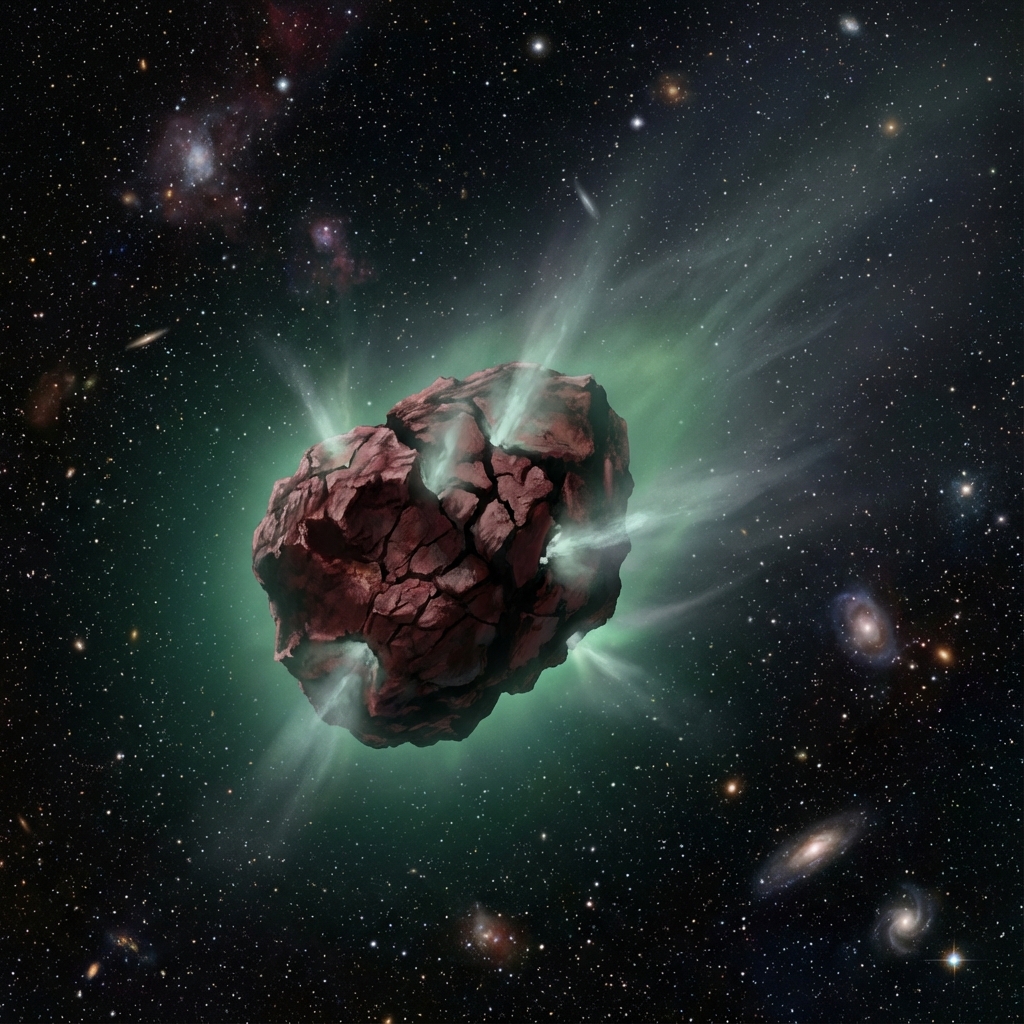 Fig 1. Generated artistic impression based on December 2025 spectral data, showing the irregular nucleus and diatomic carbon emission.
Trajectory and Final Approach
Unlike local comets bound by the Sun’s gravity, 3I/ATLAS follows a hyperbolic trajectory with an extreme eccentricity of 6.139, confirming it is unbound to our star and will never return.
- Mars Crossing: Crossed Mars’ orbit on October 3, 2025.
- Perihelion: Reached its closest point to the Sun on October 29, 2025 (1.4 AU).
- Earth Approach: Its closest approach to us is expected for December 19, 2025, passing at a safe distance of approximately 170 million miles (1.798 AU).
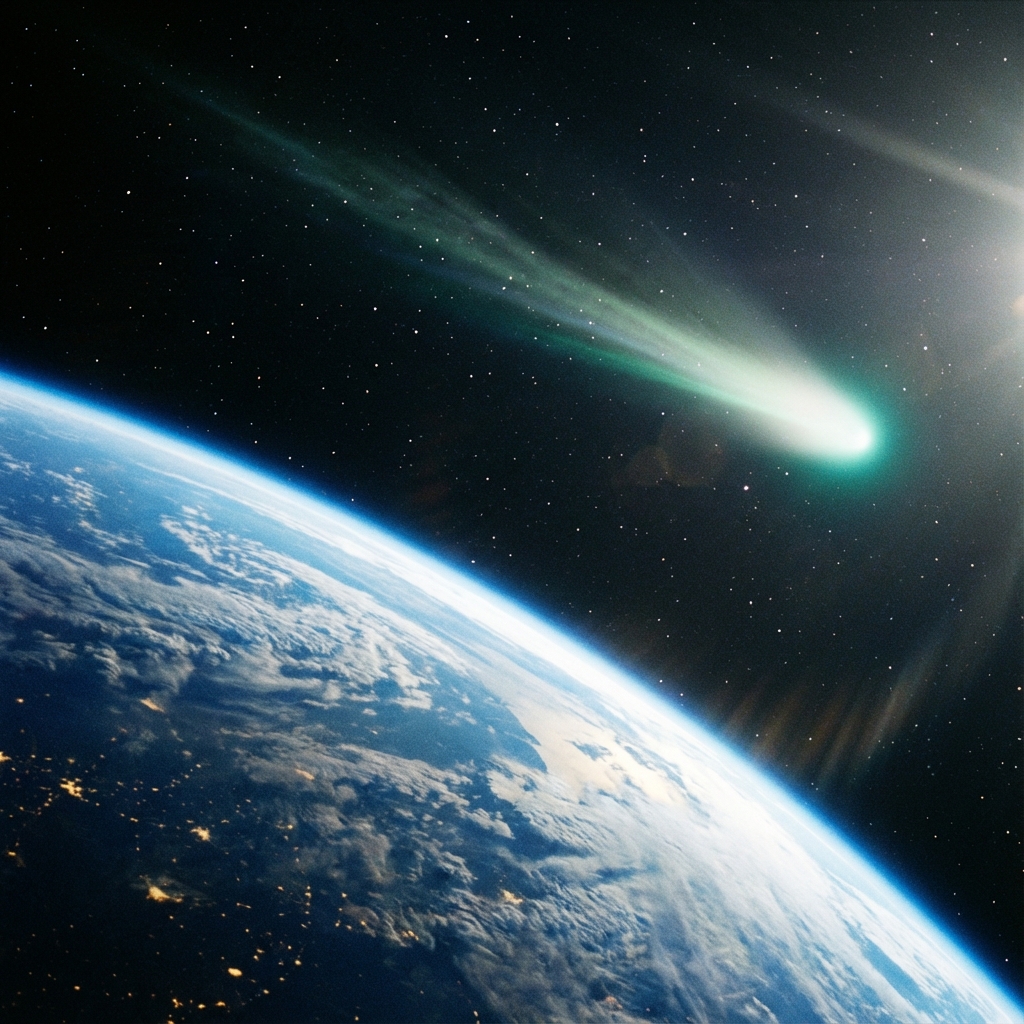 Fig 2. Artistic representation of the 3I/ATLAS close passing to Earth, visible with powerful telescopes.
Orbital calculations and recent isotopic analyses (carbon ratios and deuterium enrichment) suggest that 3I/ATLAS is not only the oldest of the three visitors but has an estimated age between 10 to 12 billion years. This makes it potentially older than our own Milky Way, considered a relic from one of the galaxy’s earliest planetary systems. Furthermore, recent estimates from the Hubble Space Telescope indicate its solid nucleus measures approximately 2.6 kilometers (1.6 miles) in diameter.
Chemical Revelations: X-rays and “Heartbeats”
Scientific updates from late 2025 and 2026 have yielded unprecedented data. For the first time in history, observatories like XRISM and XMM-Newton detected X-ray emissions from an interstellar object, a phenomenon caused by the interaction between the solar wind and the gas cloud surrounding the comet.
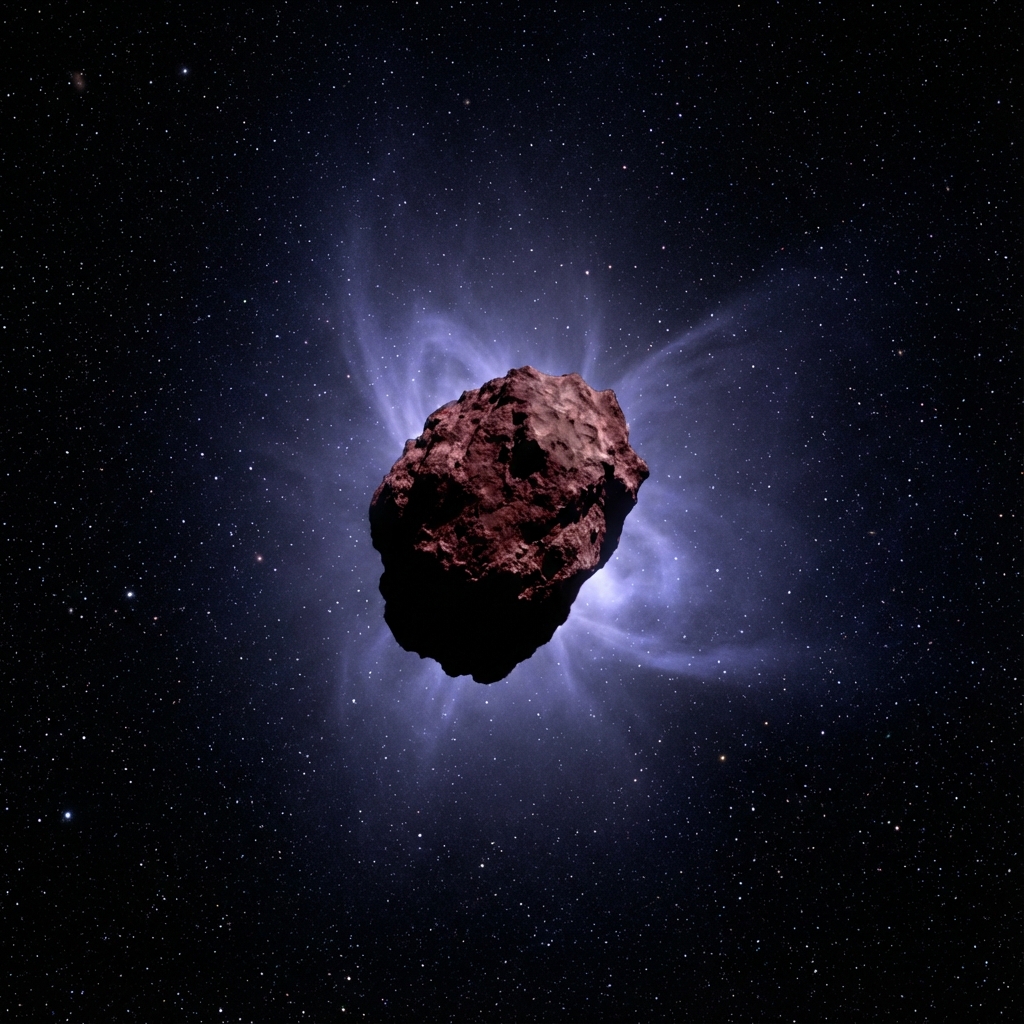 Fig 3. Simulated visualization of the unusual X-ray emission detected around the comet’s nucleus.
Reference Image: View comparison with 2I/Borisov (Hubble) Fig 4. Comparison: The interstellar comet 2I/Borisov photographed by Hubble in 2019 (Credit: NASA/ESA).

Additionally, the Gemini North telescope identified a characteristic “greenish glow,” a sign of diatomic carbon (C2) and cyanogen, while the ALMA observatory detected unusually high levels of methanol (CH3OH) and hydrogen cyanide (HCN). In recent observations, it has also been confirmed that the comet vents a rich mixture of water vapor, carbon dioxide, and methane. It is estimated that the surface possesses an “irradiated crust” forged by billions of years of exposure to intense cosmic rays.
Perhaps most intriguing is the discovery of a 16.16-hour rotation period, manifested as a regular “heartbeat” in its light curve, caused by gas jets that erupt rhythmically as they are heated by the Sun.
Theories: Natural or Artificial?
While the scientific consensus, backed by the detection of a tail and coma, points to 3I/ATLAS being a natural comet ejected from another star system, anomalies in its acceleration have reignited controversial debates.
Certain figures in the community, such as Dr. Avi Loeb from Harvard, have suggested that its precise alignment with the ecliptic plane and strange light curve could be consistent with an artificial or technological origin, similar to the theories proposed for ‘Oumuamua. However, observations from the ESA Juice spacecraft during its approach have demonstrated that its behavior was decidedly similar to that of a typical Solar System comet. The deep detection of its outgassing (colloquially, the comet’s “tail”) explains the non-gravitational acceleration perfectly naturally, increasingly ruling out the “alien spacecraft” hypothesis.
Reference Image: View comparison with 1I/’Oumuamua (Artist Concept) Fig 5. Artistic impression of the first interstellar visitor, 1I/’Oumuamua, which generated similar debates (Credit: ESO/M. Kornmesser).

Future Observations
The observation window is closing. Missions like ESA Juice and the James Webb Space Telescope (JWST) scheduled crucial observations throughout late 2025 and early 2026, before 3I/ATLAS is lost forever into the darkness of interstellar space, taking the secrets of its native system with it.
References and Sources
- XRISM/JAXA Observatory: “First X-ray Detection from Interstellar Object 3I/ATLAS”, Nature Astronomy, December 2025.
- NASA/JPL Small-Body Database: 3I/ATLAS Trajectory Data.
- ESA/XMM-Newton: “Interactive Solar Wind Bow Shock Predictions for 3I”, ESA Science Releases, Dec 3, 2025.
- Gemini Observatory Press Release: “Greenish Glow of Interstellar Visitor Explained”, Nov 2025.
- ALMA Observatory: “Methanol and HCN production rates in 3I/ATLAS”, The Astrophysical Journal Letters, Oct 2025.